Shoulder Workout Machines at the Gym: A Complete Guide for Strength, Size, and Safe Training
Shoulder Workout Machines at the Gym: A Complete Guide for Strength, Size, and Safe Training
Building strong, rounded shoulders is one of the most common fitness goals for gym-goers of all levels. Well-developed shoulders improve posture, enhance upper-body strength, and create a balanced, athletic look. One of the smartest ways to train this area is by using shoulder workout machines at the gym, especially if you want controlled movement and consistent results.
Unlike free weights, machines guide your motion, helping you focus on the muscles instead of balance. This makes them ideal for beginners, people returning after a break, and experienced lifters who want to isolate specific shoulder muscles. When used correctly, machines can deliver impressive strength and muscle growth with less joint stress.
The shoulder joint is one of the most mobile in the body, with exceptional range of motion exceeding 180 degrees. This mobility comes at the cost of stability, making shoulders vulnerable to injury. Machine-based training provides external stability while allowing progressive loading, which is particularly valuable since shoulder injuries often result from stabilizer muscle fatigue.
In this detailed guide, you’ll learn how shoulder machines work, which ones to use, and how to build an effective routine. Everything is explained in simple, friendly language so you can apply it right away during your next gym session.
Understanding Shoulder Muscles Before Using Machines
The shoulder is a complex joint made up of several muscles working together. Knowing how these muscles function will help you choose the right machines and avoid common training mistakes.
The main shoulder muscle is the deltoid, which has three parts. The front deltoid helps with pushing and lifting movements. The side deltoid is responsible for shoulder width and that capped look many people want. The rear deltoid supports posture and pulls the arms backward.
Beyond the deltoid, your shoulder includes the rotator cuff muscles (supraspinatus, infraspinatus, teres minor, and subscapularis), which stabilize during all movements. The trapezius muscles also help stabilize the scapula during overhead work. When these stabilizers are weak, the shoulder experiences increased stress, often leading to impingement. Machine training addresses these issues by allowing focused attention on movement quality.
Most shoulder workout machines at the gym are designed to target one or two of these areas at a time. This focused approach allows you to train weak points and create balanced development without overloading the joint.

Why Shoulder Workout Machines at the Gym Are Worth Using
Machines often get less attention than free weights, but they offer unique benefits that should not be ignored.
First, machines provide a fixed path of motion. This reduces the risk of poor form, which is a major cause of shoulder pain. Second, they keep constant tension on the muscle, helping you feel every repetition. Third, they allow easy weight adjustments, making progression simple and safe.
Research shows that when using free weights, approximately 30-40% of neural drive goes toward stabilization. Machines redirect this capacity toward the primary movers, potentially allowing greater muscle fiber recruitment in the deltoids. The constant tension principle is particularly important because the deltoid has a relatively short length-tension relationship, meaning it generates optimal force only through a specific range. Machines maintain load throughout the entire movement arc.
For beginners, shoulder workout machines at the gym build confidence and teach proper movement patterns. For advanced lifters, they are excellent for finishing sets or isolating muscles after heavy compound lifts.
The Most Effective Shoulder Workout Machines at the Gym
Modern gyms offer several machines designed specifically for shoulder training. Each one plays a different role in building strength and shape.

Shoulder Press Machine
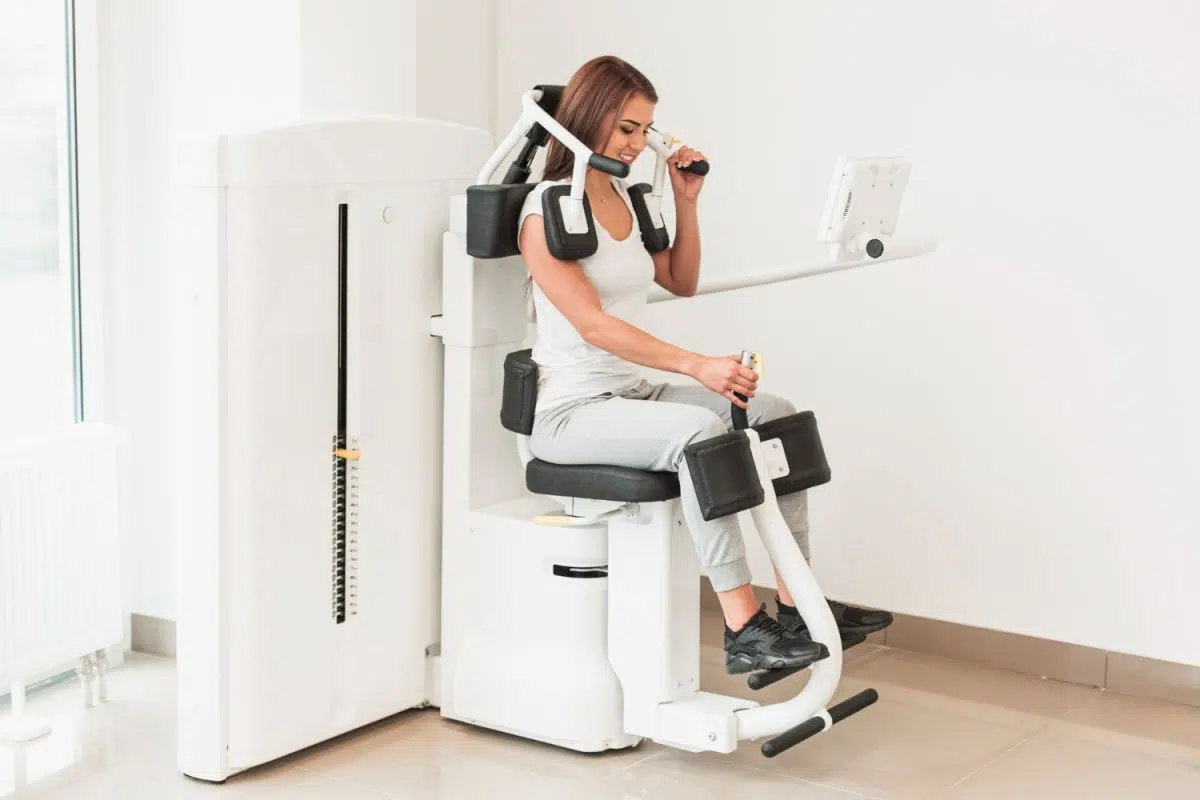
The shoulder press machine is one of the most popular choices in any gym. It mainly targets the front and side deltoids while also engaging the triceps.
You sit upright, grip the handles, and press upward in a controlled motion. The fixed path helps maintain proper alignment, reducing stress on the lower back and shoulders. This machine is perfect for beginners who want to build pressing strength safely.
Seat height adjustment is critical. The handles should align with your mid-chest to upper-chest level when seated. If too low, you’ll experience excessive internal rotation, potentially irritating the shoulder. If too high, you may recruit too much upper trapezius. The backrest angle also matters—a perfectly vertical backrest creates more overhead pressing, while a slightly reclined backrest (10-20 degrees) can be easier on the joint.
Lateral Raise Machine
If your goal is wider shoulders, the lateral raise machine is essential. It isolates the side deltoids more effectively than dumbbells for many people.
The seated position and guided movement allow you to focus entirely on lifting with your shoulders. This machine is a key part of most shoulder workout machines at the gym routines aimed at improving shoulder width.
The middle deltoid reaches peak activation between 60 and 120 degrees of abduction. The lateral raise machine maintains tension through this optimal range. Common errors include using momentum, internally rotating the shoulder excessively, and shrugging, which reduces deltoid activation.
Rear Delt Machine (Reverse Pec Deck)
Rear delts are often neglected, leading to poor posture and muscle imbalance. The rear delt machine solves this problem by isolating the back of the shoulders.
Using this machine regularly improves shoulder stability and supports other upper-body lifts. It is especially useful for people who sit for long hours or feel tightness in their shoulders.
The posterior deltoid works with the middle trapezius and rhomboids to retract and externally rotate the shoulder. In modern life, forward-reaching postures cause these muscles to become weak while anterior structures become overactive. This creates rounded shoulders and increased impingement risk. Proper execution requires chest support adjustment so shoulders are in neutral position when arms are extended.
Cable Shoulder Machine
Cable machines are incredibly versatile. With different attachments and angles, you can perform front raises, lateral raises, and rear delt movements.
Cables keep constant tension throughout the movement, which is excellent for muscle activation. Many experienced lifters combine cables with traditional shoulder workout machines at the gym for complete development.
Unlike weights that move vertically, cables provide resistance in any direction. This creates unique training opportunities since muscle fibers are oriented in various directions within the deltoid. The constant tension increases time under tension, with research suggesting 40-70 seconds per set may optimize hypertrophy.
Plate-Loaded Shoulder Press Machine
This machine feels closer to free weights while still offering guided motion. It allows each arm to work independently, helping correct strength imbalances.
Plate-loaded machines are popular in strength-focused gyms and are great for progressive overload without sacrificing safety.
Independent limb loading forces each side to handle its own resistance, revealing asymmetries that bilateral machines hide. Research indicates that strength imbalances exceeding 10-15% increase injury risk. The plate-loading system also provides more granular progression, allowing weight increases as small as 2.5 pounds per side.

Smith Machine Shoulder Press
Although not a dedicated shoulder machine, the Smith machine is commonly used for shoulder presses. The fixed bar path offers stability, making it useful for controlled pressing variations.
When used with proper form, it can be a valuable addition to a shoulder routine built around machines.
The Smith machine works best for specific applications: learning pressing patterns, training past failure safely, and isolating pressing muscles while minimizing stabilizer fatigue. Setup is critical—position yourself so the bar moves in a slightly backward trajectory. The Smith machine is best used as supplementary exercise rather than primary pressing movement.
Shoulder Workout Machines at the Gym: Quick Comparison Table
| Machine Name | Main Muscle Target | Best For | Beginner Friendly |
| Shoulder Press Machine | Front & Side Delts | Strength | Yes |
| Lateral Raise Machine | Side Delts | Width | Yes |
| Rear Delt Machine | Rear Delts | Posture | Medium |
| Cable Shoulder Machine | All Delts | Isolation | Medium |
| Plate-Loaded Press | Front & Side Delts | Power | Medium |
Machines vs Free Weights for Shoulder Training
Both machines and free weights have a place in a balanced workout. Machines offer control and isolation, while free weights improve coordination and stabilizer strength.
For people recovering from injury or focusing on muscle shape, shoulder workout machines at the gym are often the better choice. Free weights are useful for building overall strength but require excellent form.
The smartest approach is to combine both. Start with compound movements, then finish with machines to fully fatigue the shoulders without risking injury.
Free weights require coordinated activation of stabilizers, creating holistic strength development. They allow natural movement paths accommodating individual anatomy. Machines reduce stabilization demands, allowing focus on maximum force production in target muscles. For progressive overload, machines offer easier weight changes, smaller increments, and safer failure training without spotters.
Research comparing approaches shows combined training typically produces superior results. A periodized approach works well: emphasize free weights during strength phases, transition to more machine work during hypertrophy phases. Within workouts, start with compound free weights when fresh, finish with machines to accumulate volume as stabilizers fatigue.
Sample Shoulder Machine Workout Plans
Beginner Shoulder Machine Workout
This routine is simple and safe for those new to training.
Shoulder Press Machine: 3 sets of 12 reps
Lateral Raise Machine: 3 sets of 15 reps
Rear Delt Machine: 3 sets of 12 reps
Rest 60 seconds between sets and focus on slow, controlled movements.
Perform this 2 times weekly with at least 2 days rest between sessions. Warm up with 1 set at 40-50% working weight. Use 2-1-3 tempo (2-second press, 1-second pause, 3-second lower). When you complete all sets for two consecutive workouts, increase weight by 5-10 pounds.
Intermediate Shoulder Machine Workout
This plan adds volume and intensity.
Plate-Loaded Shoulder Press: 4 sets of 8–10 reps
Cable Lateral Raises: 3 sets of 12 reps
Rear Delt Machine: 3 sets of 15 reps
Smith Machine Press (light): 2 sets of 15 reps
Perform 2-3 times weekly. Use progressive overload by gradually increasing reps within ranges over weeks 1-3, then deload in week 4 (reduce volume 40-50%). After deload, increase weights 5-10% and start at lower rep ranges. Consider unilateral work occasionally to identify imbalances.
Advanced Shoulder Finisher
Use this at the end of an upper-body workout.
Lateral Raise Machine: drop sets for 3 rounds
Cable Front Raises: 3 sets of 12 reps
Rear Delt Machine: slow tempo, 3 sets of 10 reps
This finisher creates extreme metabolic stress. For drop sets: reach failure at 8-10 reps, immediately drop weight 30-40% and continue to failure, drop again and continue to failure. Rest 90-120 seconds between rounds. Use 5-second eccentrics on cable front raises and rear delt machine.
Common Mistakes to Avoid When Using Shoulder Machines
One common mistake is using too much weight. Heavy loads reduce range of motion and increase injury risk. Another issue is poor seat adjustment, which can shift tension away from the shoulders.
Many people also ignore rear delts, focusing only on presses and raises. Balanced training with shoulder workout machines at the gym requires attention to all three heads of the deltoid.
Rushing through reps is another problem. Slow, controlled movements produce better muscle activation and safer results.
Weight Selection Errors: Select weight based on what you can lift with proper form, not ego. Implement the “2-rep buffer” rule—if a set prescribes 10 reps, you should be able to complete 12 with perfect form if needed. Only the final set should approach true failure.
Setup Neglect: Adjust machines before each exercise. Seat height should align handles with mid-to-upper chest. Make micro-adjustments every 3-4 workouts based on feel. Keep notes about optimal settings.
Anterior-Posterior Imbalance: Count total weekly sets per deltoid head. Many people do 15-20 sets for front delts but only 3-6 for rear delts. A better ratio is 2:2:3 (front:middle:rear). Rear delts typically need 12-16 sets weekly to balance development.
Tempo Issues: If you must move quickly to complete a rep, the weight is too heavy. Use default tempos: 3-1-2-1 for hypertrophy (3-second lower, 1-second pause, 2-second lift, 1-second squeeze). Count in your head during reps.
Incomplete Range of Motion: Ensure full available range on every set—complete stretch position and complete contracted position. If you cannot achieve full range with current weight, reduce by 20-30% and rebuild.
Expert Tips for Better Shoulder Growth
Consistency matters more than variety. Stick to proven machines and track your progress. Increase weight gradually and prioritize form over ego lifting.
Warm up properly before heavy sets and stretch after training. Recovery plays a huge role in shoulder health and growth.
Investing in quality gym access or equipment, sometimes around $189 for specialized training tools or memberships, can make a noticeable difference in long-term results.
Progressive Overload Forms: Don’t just add weight. Also increase reps within ranges, increase sets, improve tempo control, decrease rest periods, or increase training frequency. Track all variables in a training log.
Mind-Muscle Connection: Before working sets, perform 1-2 sets of 20+ reps with ultra-light weight focusing on feeling the target muscle. Visualize the muscle contracting before each set. Touch the target muscle during warm-ups. Slower eccentrics (3-5 seconds) improve connection.
Recovery Optimization: Consume 20-40g protein within 2 hours post-workout. Get 7-9 hours sleep nightly. Implement deload weeks every 4-6 weeks (50% volume/intensity). Monitor resting heart rate—elevated indicates under-recovery.
Injury Prevention: Balance pushing and pulling volumes (1:1 ratio). Perform 2-3 sets of external rotation exercises 2x weekly. Include mobility work pre-workout. Avoid sudden volume increases exceeding 10-15% weekly. Distinguish muscle burn from joint pain—joint pain requires rest.
Real-World Benefits of Shoulder Workout Machines at the Gym
Beyond appearance, strong shoulders support daily activities and reduce injury risk. Machines allow targeted training that improves joint stability and posture.
Athletes, office workers, and older adults all benefit from controlled shoulder exercises. That is why shoulder workout machines at the gym remain a key part of smart fitness programs.
Strong shoulders improve performance across sports—overhead athletes benefit from strength reserves, contact sports need stability for impacts, endurance athletes prevent form breakdown. Manual laborers gain injury prevention, office workers correct posture issues. Daily activities like overhead reach, carrying items, and maintaining posture all improve. For aging populations, machine training provides safe, accessible strength development that can reverse 10-20 years of age-related decline.
Q&A: Shoulder Workout Machines Explained
Q1: Are shoulder machines safer than dumbbells?
Yes, machines guide movement and reduce the risk of poor form, especially for beginners.
The fixed path prevents extreme deviations from optimal positions. Machines provide continuous support—if you reach failure, you can simply release handles without danger. Stabilizer fatigue causes injuries with free weights; machines reduce these demands. However, machines still require proper setup and appropriate weights.
Q2: Can I build big shoulders using machines only?
Absolutely. With progressive overload and proper volume, machines can deliver excellent muscle growth.
Muscle hypertrophy requires mechanical tension, metabolic stress, and muscle damage—machines provide all three. Research shows similar hypertrophy between machine-only and free-weight programs when volume and intensity are equated. Key variables are progressive overload, adequate volume (12-20 sets weekly), sufficient frequency (2-3x weekly), proper nutrition, and recovery.
Q3: How often should I train shoulders on machines?
Two times per week works well for most people, allowing enough recovery.
Beginners should train 2x weekly. Intermediates can do 2-3x weekly with reduced volume per session. Advanced lifters may train 2-4x weekly using daily undulating periodization. Monitor performance—if strength consistently declines, reduce frequency. Recovery varies based on age, sleep, stress, nutrition, and total training volume.
Q4: Which machine is best for side delts?
The lateral raise machine is one of the most effective options.
It isolates middle deltoid through pure abduction. The machine maintains tension throughout the optimal 60-120 degree activation range. Seated position eliminates cheating with momentum. A comprehensive approach includes lateral raise machine for progressive overload, cable variations for different angles, and occasional dumbbells for coordination.
Q5: Do machines help prevent shoulder pain?
When used correctly, they reduce joint stress and support balanced muscle development.
Machines allow controlled paths avoiding impingement positions, systematic posterior shoulder strengthening, and reduced rotator cuff demands. They may slow cartilage degeneration through appropriate loading. However, proper setup, balanced programming, adequate recovery, and attention to pain signals remain critical.
Frequently Asked Questions (FAQs)
Are shoulder workout machines at the gym good for beginners?
Yes, they offer stability and controlled movement.
Machines teach movement patterns in a forgiving environment. Easy weight adjustment allows safe experimentation. Built-in diagrams provide instruction. Psychologically, machines reduce gym intimidation, increasing workout adherence—the most important factor for beginners.
Can I skip free weights completely?
You can, but combining both usually gives the best results.
For purely aesthetic goals, machines are sufficient. Athletes benefit from free weight stability demands for sport transfer. General fitness benefits from coordination development. Those with injury history may emphasize machines. The ideal for most people is 60-70% free weights with 30-40% machines.
How many sets should I do per machine?
Three to four sets per exercise is ideal for most goals.
Recent research suggests 10-20 sets per muscle group weekly optimizes hypertrophy. With 2x weekly training and 3-4 exercises per session, 3-4 sets per exercise works well. Beginners need 2-3 sets, intermediates 3-4 sets, advanced lifters 4-6 sets. Adjust based on individual recovery capacity.
Should I train shoulders with chest or back?
Shoulders work well with chest or as a separate session, depending on recovery.
Shoulders with chest (push day) provides similar neural patterns and time efficiency but may reduce shoulder pressing strength. Shoulders with back allows fresh pressing and good rear delt work. Separate sessions provide complete focus but require more training days. Many successful programs split shoulders: front/side delts on push day, rear delts on pull day.
Final Thoughts: Building Better Shoulders with Machines
Using shoulder workout machines at the gym is one of the most effective ways to train safely and efficiently. They help you isolate muscles, improve form, and build strength without unnecessary strain.
Whether you are just starting or refining your routine, machines offer reliable progress and long-term shoulder health. Focus on technique, stay consistent, and your shoulders will grow stronger and more defined over time.
This article is written to provide real value, practical advice, and trustworthy information so you can train with confidence and results.
Key Takeaways: Understand the three deltoid heads require different volumes. Master machine setup for safety and effectiveness. Implement various progressive overload forms. Balance training across all deltoid heads, emphasizing rear delts if needed. Control tempo through full range of motion. Ensure adequate recovery between sessions. Be patient—significant development takes months to years.
Action Plan: This week, select a workout matching your experience level and schedule 2x weekly training. This month, establish consistency and begin tracking workouts for progressive overload. This quarter, assess shoulder balance and adjust programming. This year, expect 30-50% pressing strength gains and visible development with consistency.
Remember: every advanced lifter was once a beginner who refused to quit. Start today, stay consistent, and enjoy building the shoulders you want.