
Strongman Exercises at the Gym: Build Real-World Strength, Power
Strongman Exercises at the Gym: Build Real-World Strength, Power, and Total-Body Muscle
The Strongman training has transcended its origins in elite competitions and massive outdoor arenas. Today’s fitness landscape has evolved to where many conventional gyms provide the essential tools and dedicated space necessary for performing strongman exercises safely and effectively. These specialized workouts prioritize real-world strength development, functional movement patterns, and comprehensive total-body power rather than focusing solely on aesthetic appearance.
If you’re seeking to enhance your daily strength capabilities, lift heavier loads with unwavering confidence, and challenge both your physical and mental limits, incorporating strongman exercises at the gym can revolutionize your training routine.
Unlike conventional bodybuilding programs that emphasize muscle isolation, strongman-style training compels your entire body to function as an integrated, cohesive unit. It develops strength that extends far beyond mirror aesthetics and manifests in everyday activities and real-world scenarios.
This comprehensive guide will navigate you through everything essential, from foundational beginner principles to practical gym-based exercises, all presented in clear, accessible, and experience-driven language.
Understanding Strongman Exercises: The Foundation
Strongman exercises represent functional strength movements inspired by authentic real-life tasks including carrying heavy objects, lifting awkwardly shaped loads, pushing against resistance, and pulling substantial weight across various surfaces. Rather than relying predominantly on isolated machine work, these exercises utilize free weights, loaded carries, and complex compound movements that engage multiple muscle groups simultaneously.
Within gym environments, strongman exercises are intelligently adapted using readily available equipment such as trap bars, weighted sleds, sandbags, kettlebells, and heavy dumbbells. The primary objective transcends mere muscle size development, focusing instead on cultivating usable strength, enhanced balance capabilities, superior grip power, and mental fortitude under physical stress.
Strongman exercises at gym facilities enable everyday fitness enthusiasts to train with athletic intensity without requiring competition-level specialized equipment, democratizing this powerful training methodology for the mainstream fitness community.

Compelling Reasons to Incorporate Strongman Training
Strongman-style training delivers substantial benefits that many conventional workout programs overlook or fail to address adequately. One paramount advantage is comprehensive total-body engagement, where virtually every movement pattern challenges your legs, core musculature, arms, and grip strength concurrently rather than in isolation.
Another critical benefit manifests as functional strength development. Daily activities such as transporting groceries, relocating furniture, or performing physical labor become significantly easier when you train movement patterns rather than isolated muscle groups in sterile environments.
Strongman exercises also generate substantial caloric expenditure because they involve multiple muscle systems working synergistically together, creating metabolic demands that exceed traditional isolation exercises.
From a psychological perspective, these demanding workouts build remarkable resilience and mental toughness. Managing heavy, unwieldy loads teaches focused concentration, patient persistence, and confidence under pressure. This mental edge frequently transfers beneficially into other life domains beyond the gym, improving overall life performance and stress management capabilities.
Strongman Training vs. Traditional Gym Methodologies
Traditional gym training protocols often emphasize machine-based exercises and strictly controlled movement patterns within fixed ranges of motion. While these approaches prove effective for building isolated muscle mass, they don’t consistently translate into practical real-world strength applications or functional movement capabilities.
Strongman exercises at gym settings introduce deliberate instability, dynamic movement requirements, and load management challenges. You’re not merely lifting static weight along predetermined paths; you’re actively managing, controlling, and stabilizing resistance through space.
This fundamental difference dramatically improves coordination skills, balance capabilities, and core strength in ways that fixed machines cannot replicate.
Another significant distinction involves training intensity characteristics. Strongman workouts typically involve fewer repetitions with substantially heavier loads or extended duration carries, simultaneously improving raw strength capacity and cardiovascular conditioning. The cumulative result produces a more athletic, capable, and functionally powerful physique prepared for diverse physical demands.
Essential Strongman Equipment in Standard Gyms
You don’t require access to specialized strongman training facilities to commence this training style effectively. Many standard commercial gyms already possess suitable equipment that can be creatively adapted for strongman-style training protocols.
Trap bars prove excellent for executing heavy deadlifts and loaded carries. They substantially reduce mechanical stress on the lower back while permitting aggressive loading. Dedicated farmer’s walk handles represent the ideal tool, though heavy dumbbells function as perfectly acceptable substitutes for most training purposes.
Sandbags are increasingly common in progressive gym environments and excel for loading, carrying, and lifting applications that simulate real-world object manipulation. Weighted sleds constitute another training staple, utilized for both pushing and pulling resistance exercises.
Kettlebells also play significant roles, particularly for carries and explosive movement patterns requiring ballistic strength expression.
These fundamental tools make strongman exercises at gym locations accessible and practical for most training populations, eliminating equipment barriers to entry.

Most Effective Strongman Exercises for Gym Training
Below you’ll find the most effective strongman exercises adaptable for regular gym environments. Each movement emphasizes strength development, stability enhancement, and functional power expression.
Farmer’s Walk: The Foundation Movement
The farmer’s walk ranks among the most powerful strongman exercises at gym level, delivering comprehensive benefits across multiple fitness domains. Grasp heavy dumbbells or specialized farmer’s walk handles and ambulate for prescribed distance or time duration.
This fundamental exercise simultaneously strengthens your grip endurance, core stability, leg musculature, and upper back strength through sustained isometric contraction.
Maintain an upright chest position, take deliberately controlled steps, and consciously avoid forward lean tendencies. Begin with conservative loads and progressively increase weight as technical proficiency and strength improve.
Trap Bar Deadlift: Safe Heavy Loading
This movement represents a biomechanically superior alternative to conventional barbell deadlifts for many training populations. The trap bar’s unique design allows significantly heavier loading while maintaining a more upright torso position, reducing potentially problematic shear forces on the lumbar spine.
Trap bar deadlifts build formidable leg strength, back power, and overall body coordination through natural movement patterns. They constitute a cornerstone exercise for gym-based strongman training protocols due to their safety profile and effectiveness.
Sandbag Load and Carry: Unstable Load Management
Sandbags brilliantly simulate awkward real-life loads that shift and redistribute during handling. Lift the bag from floor level, embrace it securely against your chest, and carry it for prescribed distance. Advanced variations include loading the sandbag onto elevated platforms, simulating real-world lifting tasks.
This exercise comprehensively challenges your core stabilization, arm strength, and respiratory capacity while teaching valuable lessons about managing unstable, shifting weight that translates directly to practical applications outside the gym environment.
Sled Push and Pull: Explosive Power Development
Sled work builds explosive leg power and cardiovascular endurance simultaneously without the joint stress associated with high-impact activities. Push the loaded sled forward using powerful, abbreviated steps or pull it backward using attached straps or ropes, engaging different muscle groups and movement patterns.
This movement proves remarkably joint-friendly while delivering exceptional effectiveness for conditioning and lower-body power development, making it suitable for various training populations including those managing joint concerns.
Overhead Press Variations: Upper Body Power
If your training facility lacks a specialized strongman log, standard barbells or heavy dumbbells serve as excellent substitutes. Overhead pressing movements build shoulder strength, triceps power, and core stability through integrated full-body tension.
Pressing substantial weight overhead while maintaining a standing position forces your entire body to remain tight and controlled, teaching valuable lessons about creating and maintaining full-body tension under load.
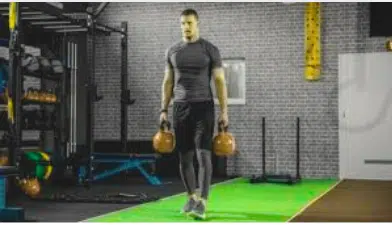
Heavy Kettlebell Carry: Unilateral Strength
Grasp one or two kettlebells and walk with controlled deliberation. This deceptively simple exercise improves grip endurance, postural strength, and core stability through sustained isometric work. Single-arm carry variations additionally challenge balance and anti-rotational core strength as your body resists lateral displacement.
Herer is Exercise Overview: Muscles and Benefits
| Exercise | Primary Muscles Targeted | Key Training Benefit |
| Farmer’s Walk | Grip, Core, Legs, Upper Back | Total-Body Stability & Endurance |
| Trap Bar Deadlift | Legs, Back, Glutes, Core | Safe Heavy Loading Capacity |
| Sandbag Carry | Core, Arms, Shoulders, Back | Real-World Strength Transfer |
| Sled Push/Pull | Legs, Glutes, Calves, Core | Explosive Power & Conditioning |
| Overhead Press | Shoulders, Triceps, Core | Upper-Body Strength & Stability |
| Kettlebell Carry | Grip, Core, Shoulders, Legs | Unilateral Strength & Balance |
Beginner-Friendly Strongman Workout Structure
If you’re new to strongman exercises at gym training, commence with two or three dedicated sessions weekly, allowing adequate recovery between training days. This frequency permits consistent skill development while preventing overtraining and excessive fatigue accumulation.
Training Day 1: Lower Body and Grip Focus
- Trap Bar Deadlift: 4 sets of 5 repetitions with progressive loading
- Farmer’s Walk: 4 rounds of 30-40 seconds duration
- Sled Push: 3 rounds of 20-30 meters
Training Day 2: Upper Body and Carries
- Sandbag Carry or Load: 4 rounds for distance or height
- Standing Overhead Press: 4 sets of 6-8 repetitions
- Kettlebell Carry (single or double): 3 rounds of 30-40 seconds
Schedule at least one complete rest day between strongman training sessions to facilitate recovery. Prioritize movement quality and technical proficiency over absolute loading, gradually progressing resistance as competence improves.
Critical Safety Guidelines for Strongman Training
Comprehensive warm-up protocols prove essential before engaging heavy loads or challenging carries. Dedicate adequate attention to grip preparation and utilize lifting chalk when facility regulations permit. Begin with substantially lighter loads than your perceived capacity, methodically building strength and technical competence over extended timelines.
Never rush through carries or lifting movements. Controlled, deliberate execution significantly reduces injury probability while improving movement quality. Recovery deserves equal priority with training intensity, so prioritize quality sleep, manage training volume intelligently, and listen attentively to your body’s feedback signals.
If you experience sharp pain, joint discomfort, or concerning symptoms, cease training immediately and consult qualified medical professionals. Persistent minor discomfort warrants technique evaluation and potential load reduction to prevent minor issues from developing into serious injuries.
Who Benefits from Strongman Training?
Strongman exercises prove suitable across diverse training populations including absolute beginners, experienced lifters seeking novel challenges, competitive athletes requiring functional strength, and even bodybuilders looking to supplement aesthetic training with practical power development. Women benefit equally from strongman training, particularly regarding confidence building and comprehensive full-body power development.
You don’t require competitive aspirations to train using strongman methodologies. The substantial benefits apply universally to anyone seeking practical, transferable strength that enhances daily life quality and physical capability. Age, gender, and experience level present no barriers when training is appropriately scaled to individual capacity.
Older adults can particularly benefit from strongman training’s emphasis on functional movement patterns that directly translate to activities of daily living, potentially extending independence and quality of life through maintained physical capability.
Nutrition and Recovery Strategies
Strongman-style workouts create substantial nutritional demands requiring strategic fueling protocols. Consume adequate protein quantities to facilitate muscle repair and adaptation, typically ranging from 0.7 to 1.0 grams per pound of body weight daily. Include sufficient carbohydrates to replenish glycogen stores and fuel intense training sessions, particularly around workout timing.
Hydration proves essential, especially during extended carries and demanding sled work that generate significant sweat loss and fluid requirements. Monitor urine color as a practical hydration indicator, targeting pale yellow coloration throughout the day.
Recovery tools including foam rollers, massage devices, mobility work, and targeted joint care represent worthwhile investments in training longevity. Some practitioners find that allocating resources toward recovery equipment and grip-specific tools adds substantial long-term value to their training outcomes and injury prevention efforts.
Psychological Benefits of Strongman Training
Managing heavy, awkward loads under challenging conditions builds exceptional mental toughness and psychological resilience. You develop the capacity to remain composed under physical pressure while trusting your body’s strength capabilities. This mental fortitude frequently transfers beneficially to professional challenges, personal obstacles, and stressful situations beyond the gym environment.
Strongman exercises at gym routines effectively combat training monotony and staleness. Each session presents as a distinct challenge rather than repetitive routine, maintaining engagement and motivation over extended training periods. The varied, dynamic nature of strongman work keeps training psychologically fresh and mentally stimulating.
Successfully completing challenging strongman workouts generates profound confidence that extends beyond physical domains. You develop self-efficacy and belief in your capability to overcome difficult challenges through persistent effort and intelligent strategy.
Common Training Mistakes to Avoid
Avoid ego-driven lifting and utilizing loads exceeding your current technical proficiency and strength capacity. Patience proves essential for long-term progress and injury prevention. Skipping comprehensive warm-up protocols represents another frequent error that significantly increases injury probability.
Don’t neglect grip strength development, as it constitutes an essential component of strongman success that often limits performance before other muscle groups fatigue. Dedicated grip training through hangs, dead holds, and grip-specific tools pays substantial dividends in carrying capacity and overall performance.
Overtraining can substantially impede progress and increase injury risk. Listen attentively to your body’s recovery signals and adjust training volume when fatigue accumulates excessively. More training doesn’t always produce better results; intelligent training with adequate recovery generates optimal outcomes.
Failing to video record technique for self-assessment represents a missed opportunity for continuous improvement. Regular technique review identifies subtle form breakdown and allows proactive correction before inefficient patterns become ingrained habits.
Comprehensive Q&A Section
Can strongman exercises completely replace traditional workouts?
They certainly can for many training goals, though numerous practitioners prefer combining strongman training with traditional modalities for balanced development. Pure strongman training comprehensively develops strength, power, and conditioning, though some individuals appreciate supplementing with isolation work for specific muscle groups or aesthetic goals.
Are strongman exercises exclusively for large, heavily muscled lifters?
Absolutely not. Anyone can scale loading appropriately and benefit substantially from strongman training principles. The movements remain fundamentally identical regardless of weight used, making them accessible across all strength levels. Smaller individuals often excel at strongman training through superior technique and relative strength.
How quickly will visible results manifest?
Most dedicated practitioners notice significant strength gains and enhanced confidence within several weeks of consistent training. Visible physique changes typically require six to twelve weeks of consistent effort combined with appropriate nutrition. However, functional strength improvements often manifest noticeably faster than aesthetic changes.
Do strongman workouts effectively support fat loss goals?
Yes, substantially. They generate exceptional caloric expenditure while building muscle mass that elevates resting metabolic rate. The combination of heavy loading and cardiovascular demands creates favorable conditions for body composition improvement when paired with appropriate nutritional strategies.
Is specialized equipment absolutely required?
No, most conventional gyms already possess adequate equipment for effective strongman training. Creativity and adaptation allow excellent training with standard gym implements. While specialized equipment offers advantages, it’s not prerequisite for achieving excellent results.
Frequently Asked Questions
Are strongman exercises at gym appropriate for complete beginners?
Yes, when executed with proper technical instruction and moderate loading that respects current capacity. Beginners should prioritize movement quality over absolute weight, gradually building competence before pursuing heavy loads.
What training frequency proves optimal for strongman work?
Two to three dedicated sessions weekly proves ideal for most training populations, providing adequate stimulus while permitting sufficient recovery. Advanced practitioners may tolerate higher frequencies, while beginners might benefit from starting with two weekly sessions.
Do strongman exercises effectively build muscle mass?
Absolutely. They stimulate substantial muscle growth through heavy compound movements and extended time under tension during carries. The combination of mechanical tension, metabolic stress, and muscle damage creates ideal conditions for hypertrophy across all major muscle groups.
Can women effectively perform strongman exercises?
Yes, and many women find strongman training particularly empowering and effective for building practical strength and confidence. Women respond identically to training stimuli as men, achieving proportional strength gains and enjoying equal benefits from strongman methodologies.
How does strongman training compare to CrossFit?
While both emphasize functional fitness, strongman training typically involves heavier loads, longer rest periods, and less cardiovascular emphasis compared to CrossFit’s high-intensity interval approach. Strongman focuses more on absolute strength development, while CrossFit balances strength with conditioning and gymnastics elements.
Expert Tip:
Focus on proper form and controlled carries before increasing weight, as strongman training rewards consistency and technique more than ego lifting.
Final Thoughts: Embracing Strongman Training
Strongman exercises at gym settings deliver a transformative approach to building authentic real-world strength, psychological resilience, and unshakeable confidence. They transcend superficial aesthetics, focusing instead on what your body can genuinely accomplish under challenging conditions.
By training intelligently, maintaining consistency, and respecting recovery requirements, you can unlock strength levels that support and enhance everyday life in meaningful ways.
Whether your goals center on improved general fitness, functional power development, or enhanced mental toughness, strongman-style training delivers lasting value that extends far beyond the gym walls. This training approach aligns perfectly with the philosophy of building strength that’s practical, achievable, and constructed with clear purpose.
Start where you are, use what equipment you have available, and progress systematically. Strongman training rewards patience, consistency, and intelligent effort with strength that genuinely serves you throughout life’s physical demands. The journey may challenge you, but the resulting capabilities and confidence make every demanding set worthwhile.
Remember: true strength isn’t measured solely by numbers on a bar, but by your capability to handle whatever life requires with confidence and competence. Strongman training builds exactly that kind of strength.