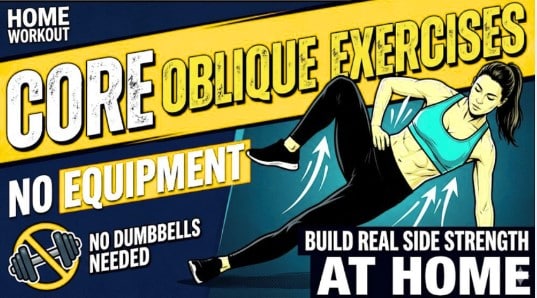
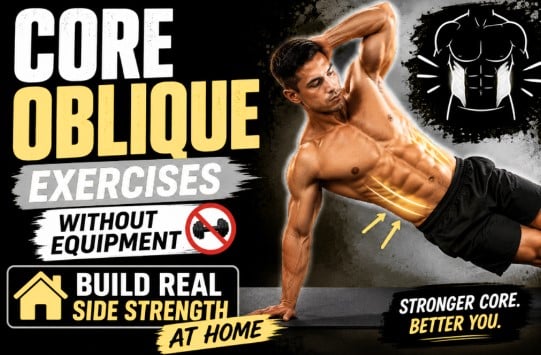
Core oblique exercises without equipment || Build Real Side Strength at Home
Core Oblique Exercises Without Equipment || Build Real Side Strength at Home
Most people train their abs and completely forget about their obliques. That is a problem. Your oblique muscles run along both sides of your core, and they control rotation, lateral movement, and spinal stability. Without strong obliques, your posture suffers, your lower back takes more stress, and your overall athletic performance stays limited.
The good news is you do not need a cable machine, a gym membership, or any oblique exercises gym equipment to actually build them. Core oblique exercises without equipment are some of the most effective movements you will find, and they work whether you are a beginner training in a hotel room or an experienced athlete adding work at home. This article covers exactly what to do, why each movement works, and how to organize it all into a real routine.
Key Takeaways Core Oblique Exercises Without Equipment
- Your obliques have two layers, internal and external, and you need both types of movements to train them properly.
- Bodyweight oblique exercises, when done with proper form and tension, produce real strength and muscle development.
- Rotation and lateral flexion are the two primary movement patterns your oblique training should include.
- Consistency beats intensity. Three targeted sessions per week outperforms one brutal session.
- A $120 investment in a pull-up bar later opens up hanging oblique exercises, but until then, the floor movements below are enough.
Why Your Obliques Deserve More Attention
Your core is not just the front of your stomach. It wraps around your entire midsection, and the obliques are a large part of that system. The external obliques sit on the outer surface of your ribcage and run diagonally downward. The internal oblique exercises target the deeper layer just beneath, running in the opposite diagonal direction. Together, they handle trunk rotation, lateral bending, and protecting your spine under load.
When you skip oblique training, other muscles compensate. Your lower back gets overworked during lifting and twisting. Your hips rotate unevenly during running and sport. Even your breathing mechanics suffer because the obliques assist with forced exhalation. Strong obliques are not about aesthetics first. They are about building a core that actually functions under real-world conditions.
How Core Oblique Exercises Without Equipment Actually Work
The reason bodyweight oblique training works so well is that your obliques respond to tension and time under load, not just resistance. When you hold a side plank, your obliques are under sustained isometric contraction. When you do a bicycle crunch, they fire through a full rotational range of motion. Neither movement needs weight to produce a training effect.
Research consistently shows that exercises like the bicycle crunch activate the obliques at a higher level than many machine-based movements. A study published in the Journal of Strength and Conditioning Research found that bodyweight core exercises produce comparable muscle activation to weighted alternatives when performed with proper technique and sufficient volume. Your obliques do not know the difference between a cable stack and your own bodyweight. They only know tension.
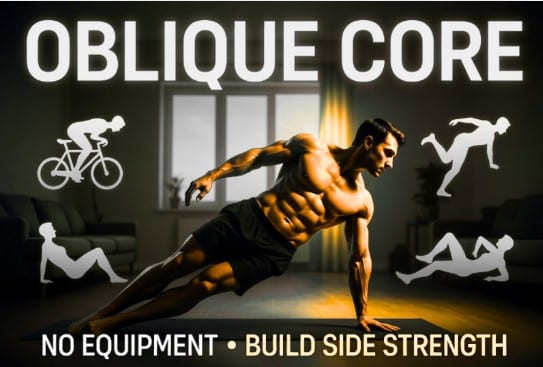
The Best Core Oblique Exercises Without Equipment
1. Bicycle Crunch
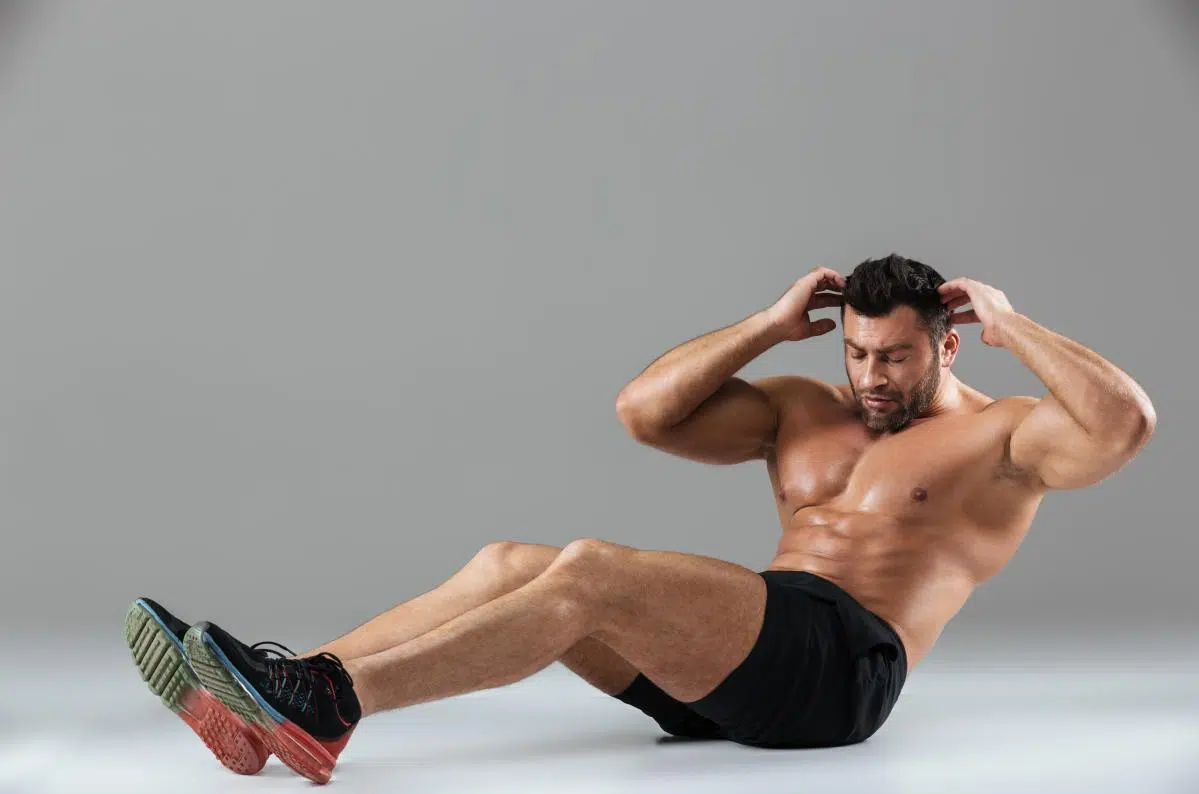
The bicycle crunch is one of the most effective oblique exercises for targeting both the external and internal oblique in a single movement. Lie on your back, hands lightly behind your head, and bring one knee toward your chest while rotating your opposite elbow toward it. The key word is rotate, not reach. Your shoulder blade needs to lift off the ground, and you should feel the twist deep in your side, not just your neck.
Do this slowly. A fast bicycle crunch turns into momentum work, and your obliques stop being the prime mover. Aim for 3 sets of 15 to 20 controlled reps per side. Pause briefly at the point of full rotation before switching sides.
Quick Tip : about Core Oblique Exercises Without Equipment
Keep your lower back pressed into the floor throughout. If it lifts, you have lost tension in your core and shifted the work elsewhere.
2. Side Plank
The side plank is the foundation of any no-equipment oblique routine. It works the obliques isometrically, meaning they contract without shortening or lengthening. This builds the deep stabilizing strength that dynamic movements alone do not provide. Stack your feet, place your elbow directly under your shoulder, and lift your hips until your body forms a straight line from head to foot.
Most people hold for time, but a more effective approach is to add a small hip dip at the bottom of the range, lower slightly, then return to the top. This adds a dynamic component that increases oblique activation significantly. Work up to 3 sets of 30 to 45 seconds per side, or 10 to 15 controlled hip dips.
Expert Tip: Film yourself from the side once. Most people either sag at the hips or pike upward. Neither is correct. Your body should be one straight line.
3. Russian Twist
The Russian twist is a sitting oblique exercise that trains rotational strength through a full range of motion. Sit on the floor with your knees bent, lean back slightly until you feel your core engage, and rotate your torso from side to side. Touch the floor beside each hip with both hands on every rep. The lean-back angle is what makes this exercise work. Too upright and your obliques barely fire. Too far back and your hip flexors take over.
No weight needed here. The bodyweight version, done with a slow and controlled tempo, is already a solid challenge. When it gets easy, lift your feet off the floor. This removes your base of support and forces your obliques to work harder to control the rotation.
4. Dead Bug with Rotation
The dead bug is traditionally a core stability exercise, but adding a rotational component turns it into one of the more effective internal oblique exercises in a no-equipment format. Lie on your back, arms extended toward the ceiling, knees bent at 90 degrees. Lower one arm overhead while extending the opposite leg, but before you do, rotate your raised arm slightly across your body. This cross-body element activates the internal obliques and the transverse abdominis together.
This movement is subtle but demanding. If you feel your lower back arch during the extension, reduce your range of motion. The goal is controlled movement with full tension, not a large range with a loose spine.
5. Heel Tap
The heel tap is a short-range oblique exercise that most people underestimate. Lie on your back, knees bent, feet flat on the floor. Reach sideways along the floor and tap your right hand to your right heel, then left hand to left heel, alternating. The lateral flexion movement fires the obliques on the side you are reaching toward.
This is a lower-intensity movement, which makes it good as a warm-up or as a finisher after harder exercises. Volume is the key here. Three sets of 20 taps per side produces a real burn.
6. Windshield Wiper (Modified)
Lie on your back with your knees bent and feet lifted so your shins are parallel to the floor. Slowly lower both knees to one side, stopping before they touch the ground, then return to center and lower to the other side. Your obliques control the lowering and the return.
This is a genuine oblique exercise. The movement pattern requires your obliques to resist rotation on the way down and produce rotation on the way back up. A full range of motion with slow, controlled movement gives you the most benefit. Three sets of 8 to 10 reps per side works well here.
7. Standing Side Crunch
Standing oblique work is often overlooked in home training. Stand with feet shoulder-width apart, hands behind your head. Drive one knee upward and laterally while bringing the same-side elbow down to meet it. This lateral flexion pattern directly targets the obliques on the side you are crunching toward.
Standing oblique exercises are also more functional because your obliques fire while bearing your body weight in an upright position, which is closer to how they work during real activities. Four sets of 12 to 15 reps per side builds both strength and endurance in the muscle.
How to Build These Into a Weekly Routine
| Day | Focus | Exercises |
| Monday | Dynamic Rotation | Bicycle Crunch, Russian Twist, Standing Side Crunch |
| Wednesday | Stability + Lateral | Side Plank, Heel Tap, Windshield Wiper |
| Friday | Full Core Integration | Dead Bug with Rotation, Side Plank Hip Dip, Russian Twist |
This structure covers both rotational and lateral oblique work across the week. Rest at least one day between sessions to allow the muscle tissue to recover. Obliques are not a daily training muscle, even though many programs treat them that way.
Common Mistakes That Kill Your Progress
Rushing Through Reps
Speed is the enemy of oblique training. When you move fast, your hip flexors and momentum take over. Slow down. A 2-second concentric and 3-second eccentric tempo on every rep keeps your obliques under tension long enough to actually stimulate them.
Only Training One Side
It is easy to default to your stronger side and coast through reps on the weaker one. Deliberately match volume and effort on both sides. Unilateral weakness in the obliques is one of the most common contributors to lower back pain and hip misalignment during athletic movement.
Neglecting the Internal Obliques
Most people only do exercises they feel burning on the outside. The internal oblique exercises listed above, particularly the dead bug with rotation and the windshield wiper, require more focus to feel, but they build the deep stability layer that protects your spine. Do not skip them because they are less satisfying.
Q&A: Real Questions About Oblique Training
Q: How long does it take to see results from oblique exercises without equipment? Most people notice a difference in core stability and posture within 3 to 4 weeks of consistent training. Visible muscle definition on the sides depends on overall body fat percentage and takes longer.
Q: Are bodyweight oblique exercises as effective as dumbbell oblique exercises? For building functional strength and endurance in the obliques, bodyweight work is highly effective. Dumbbell oblique exercises add load and become more useful once bodyweight work gets easy. For most people at home, bodyweight training produces real results for months before they need external resistance.
Q: How many times per week should I train obliques? Two to three times per week is the standard recommendation. Your obliques recover like any other muscle, and overtraining them creates fatigue without additional benefit.
Q: What is the difference between internal and external oblique exercises? External oblique exercises tend to involve lateral flexion and rotation toward the opposite side. Internal oblique exercises involve rotation toward the same side and deep stabilization. Most compound movements like the bicycle crunch train both simultaneously.
Q: Should I train obliques before or after my main workout? After. If you fatigue your obliques before squats, deadlifts, or other compound movements, you remove an important stabilizing muscle from those lifts. Train obliques at the end of your session.
FAQs : about Core Oblique Exercises Without Equipment
Do oblique exercises reduce side fat? No exercise reduces fat in a specific area. Oblique training builds and strengthens the muscle beneath the fat. Reduction in side fat comes from overall caloric deficit and general exercise programming.
Are sitting oblique exercises effective? Yes. Sitting oblique exercises like the Russian twist are effective because the sitting position reduces hip flexor involvement and forces more of the work onto the core. The key is maintaining a slight lean back and controlling the rotation.
What are the most effective oblique exercises overall? Based on muscle activation research, the bicycle crunch, side plank, and hanging oblique exercises rank among the most effective. Hanging knee raises with rotation, in particular, produce high oblique activation because they combine hip flexion with rotational load.
Can I do oblique exercises every day? You technically can, but it is not optimal. Daily training without adequate recovery reduces the quality of each session and slows overall strength development. Two to three sessions per week with full effort outperforms daily low-quality work.
Are cable oblique exercises better than bodyweight? Cable oblique exercises offer the advantage of consistent tension throughout the range of motion, which is useful for advanced training. For most people, bodyweight oblique exercises provide enough challenge and stimulus to build solid oblique strength without any equipment.
Building Strength on Your Own Terms
Core oblique exercises without equipment work because your obliques respond to tension and controlled movement, not machines or special gear. The movements covered here, from the bicycle crunch to the windshield wiper, build both layers of your obliques, improve rotational strength, and support long-term spinal health. The routine structure gives you a simple framework to follow.
What matters now is putting in the reps consistently. Your obliques will get stronger, your posture will improve, and your whole core will function better. You do not need a gym to build that. You need the floor beneath you and the right movements.