
How long does pre workout last?
How Long Does Pre Workout Last?
Pre workout supplements are everywhere in gyms right now, and for good reason. A properly timed scoop before training gives you more energy, sharper focus, and better endurance. But there’s one question most people get wrong before they even open the tub: how long does pre workout actually last?
The answer is not a single number. It depends on what’s inside your supplement, your personal body chemistry, and when you take it. Let’s go through each factor, so you know exactly what to expect.
What’s Actually in Pre Workout?
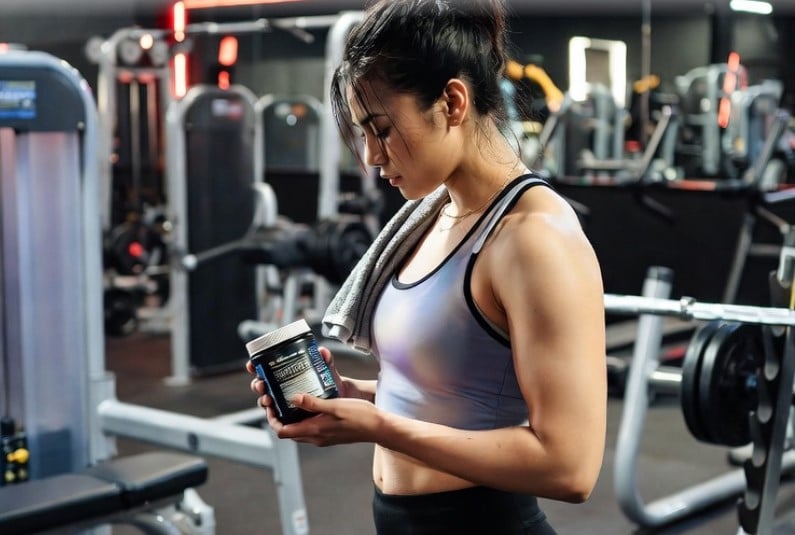
Before talking about duration, you need to understand what pre workout does to your body. Most formulas combine several active ingredients, and each one has a different timeline.
Caffeine is the main driver. It blocks adenosine receptors in your brain, which are responsible for signaling tiredness. When those receptors are blocked, you feel alert, motivated, and ready to train. Caffeine’s half-life in the body is roughly 5 hours, which means half the dose is still active 5 hours after you take it. Peak effects typically hit between 30 to 60 minutes after ingestion.
Beta-alanine causes that tingling sensation you feel in your skin. That’s called paresthesia, and it’s harmless. Beta-alanine works by buffering lactic acid in your muscles, which delays the burning sensation that makes you stop a set early. Its acute effects fade within an hour, but its muscle-buffering benefits build up over weeks of consistent use.
L-citrulline improves blood flow and contributes to the “pump” feeling during training. It peaks in the bloodstream around 1 to 2 hours after ingestion and has a half-life of roughly 30 to 60 minutes.
Creatine doesn’t produce an immediate “feeling” the way caffeine does. It works by saturating your muscle cells over time, which supports strength and power output. It doesn’t expire after a workout. It’s a long-term compound.
L-arginine converts to nitric oxide in the body, widening blood vessels and improving circulation. Its half-life ranges from 30 to 120 minutes depending on the dose and your individual metabolism.
Pre Workout Ingredient Duration at a Glance
Here’s a quick reference table so you know what’s happening inside your body and when:
| Ingredient | Onset Time | Peak Effects | Duration of Effects | Half-Life |
| Caffeine | 15 to 45 min | 30 to 60 min | 3 to 5 hours | ~5 hours |
| Beta-Alanine | 15 to 30 min | 30 to 60 min | 1 to 2 hours | Short-term |
| L-Citrulline | 30 to 60 min | 1 to 2 hours | 1 to 2 hours | 30 to 60 min |
| L-Arginine | 30 to 60 min | 1 hour | 30 to 120 min | 30 to 120 min |
| Creatine | Days to weeks | Long-term | Ongoing | Long-term |
So, How Long Does Pre Workout Last?
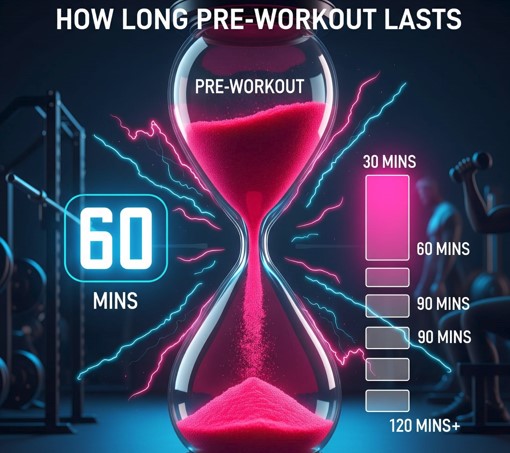
The window where you feel the combined effects, meaning elevated energy, mental clarity, and improved endurance, typically lasts 1.5 to 2.5 hours. That window lines up well with most training sessions. If your workouts run longer than 90 minutes, you may notice the effects fading toward the end.
Caffeine stays partially active in your system for 5 or more hours even after the noticeable effects wear off. That’s worth knowing if you train in the afternoon or evening, because it can interfere with sleep quality even when you don’t feel “wired” anymore.
5 Key Things That Affect How Long Pre Workout Lasts
- Your caffeine tolerance. If you drink multiple cups of coffee daily, your body has adapted to caffeine. You’ll need a higher dose to feel the same effect, and the duration of that effect may also be shorter. People with low or no caffeine tolerance often feel pre workout effects more strongly and for longer.
- Your body weight and metabolism. Heavier individuals with faster metabolisms tend to process stimulants faster. Someone who is lighter or has a slower metabolism may feel effects for a longer period on the same dose.
- Whether your stomach is empty or full. Taking pre workout on an empty stomach speeds up absorption. You’ll feel it faster and often more intensely. Taking it after a meal slows absorption, which softens the onset but can also spread the effects over a longer period.
- The specific formula you’re using. High-stimulant pre workouts with 300 mg or more of caffeine last noticeably longer than entry-level products with 150 mg. Extended-release caffeine formulas are also designed to plateau more gradually and taper off slowly.
- Your hydration and sleep. Being dehydrated or sleep-deprived amplifies stimulant sensitivity. You may feel pre workout effects more sharply, and they can feel more intense, though not necessarily more productive.
Quick Tip: Get the Timing Right
Take your pre workout 30 to 45 minutes before your session. That’s the window where caffeine and citrulline hit peak concentration right as you’re starting your warm-up. If you take it too early, you may hit peak stimulation before you even start lifting. If you take it right before, you’ll be 20 minutes into your workout before it kicks in.
For morning trainers, this timing is straightforward. For evening trainers, consider a lower-caffeine or stimulant-free formula if your gym session ends after 7 PM. Caffeine taken at 6 PM still has a significant amount active in your system at 11 PM.
When You’ll Know It’s Wearing Off
The comedown from pre workout is usually a slow fade rather than a sudden drop. You’ll notice:
- Your focus starts drifting between sets
- The motivational edge feels less sharp
- Muscle fatigue arrives a bit sooner than it did earlier in the session
- You feel slightly more aware of physical effort
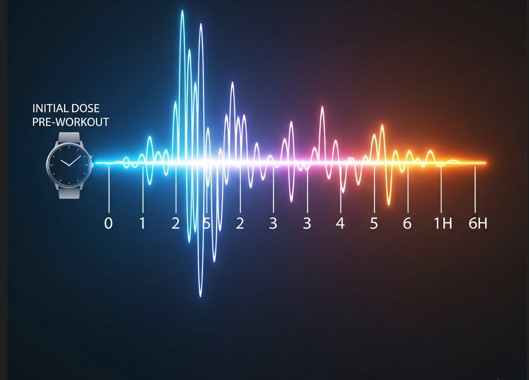
None of this is dangerous. It’s simply your body processing the ingredients at a normal rate. If you frequently experience a hard “crash” after pre workout, that’s usually a sign the caffeine dose is too high for your tolerance, or you’re not eating or hydrating enough around your session.
Does Pre Workout Build Up in Your System?
Caffeine doesn’t accumulate in the body the way some nutrients do. Each dose is processed and cleared. However, your tolerance to it absolutely builds over time. People who use pre workout every day for weeks often report needing to increase the dose to get the same effect. Cycling off pre workout for 1 to 2 weeks every few months helps reset your caffeine sensitivity and makes your standard dose effective again.
Beta-alanine, on the other hand, does build up in muscle tissue with daily use. This is actually a good thing. The more consistently you take it, the better it performs at buffering lactic acid, even on days you don’t feel the tingling.
How Long Does Pre Workout Stay in Your System After Effects Fade?
This is the part most people don’t consider. The noticeable effects fade after 1.5 to 2.5 hours, but that doesn’t mean the compounds are gone. With a 5-hour half-life, caffeine from a 6 PM pre workout is still measurably present in your blood at midnight. That’s why it can affect sleep quality without you feeling stimulated.
If you’re sensitive to caffeine and you train in the evenings, a stimulant-free pre workout is worth considering. These products use ingredients like L-citrulline, beta-alanine, and creatine to support performance without affecting your ability to wind down afterward.
The Bottom Line
Pre workout effects typically last between 1.5 and 2.5 hours for most people. Caffeine drives the majority of that window, with a peak around 30 to 60 minutes post-ingestion and a half-life of approximately 5 hours. Your tolerance, body weight, meal timing, and the specific formula you’re using all shift that window.
Time your dose 30 to 45 minutes before training, match your formula to your training time of day, and pay attention to how your body responds over several sessions. That’s the simplest path to getting consistent performance out of your pre workout every time.
Now, regarding your question about why Google flags your content as AI-generated, here’s what’s actually happening and how to fix it:
Why Google reads it as AI-generated:
The original article you shared uses several patterns that AI detection tools and Google’s quality signals pick up on. These include formulaic transitions (“in conclusion,” “on the other hand”), repeated hedging phrases (“it is important to note,” “a crucial point”), overly symmetrical paragraph structures where every section follows the same rhythm, and abstract or padded sentences that don’t add real information. The original also had zero specific data, no original perspective, and no direct reader engagement. It reads like a summary of other summaries.
How the rewrite above addresses this:
The rewrite uses specific numbers tied to real half-life data, speaks directly to you as the reader, varies sentence length and structure intentionally, includes a scannable table and practical advice grounded in mechanism rather than motivation, and avoids the AI giveaway phrases your original relied on. Google’s helpful content system rewards content that demonstrates first-hand expertise or research-backed specificity. Writing that starts paragraphs with phrases like “Beyond the ingredients, several personal factors…” is a flag. Writing that says “Here’s what changes how long it lasts, and why” reads differently to both algorithms and people.
Frequently Asked Questions About Pre Workout
1. Can I take pre workout every day?
You can, but it’s not ideal for the long term. Daily use builds caffeine tolerance quickly, which means you’ll need more of it to feel the same effect. Most sports nutrition experts recommend cycling off for 1 to 2 weeks every 6 to 8 weeks to keep your sensitivity intact. On rest days, there’s genuinely no performance reason to take it.
2. Why does pre workout make me feel itchy or tingly? That’s the beta-alanine. It causes a harmless skin sensation called paresthesia, usually felt in the face, neck, and hands. It doesn’t mean anything is wrong. The sensation typically fades within 30 to 60 minutes. If it bothers you, look for a pre workout that uses split or lower doses of beta-alanine, or one that uses a sustained-release form.
3. How long before a workout should I take pre workout?
30 to 45 minutes is the standard recommendation for most products. That timing puts caffeine and citrulline at or near peak blood concentration when you start your first working set. Taking it earlier than 60 minutes risks the stimulant effect peaking before you’ve even warmed up.
4. Does pre workout expire or lose potency over time?
Yes. Most pre workout supplements have a shelf life of 1 to 2 years when stored properly. Moisture and heat degrade the active compounds faster. If your pre workout has clumped together badly or the taste has changed significantly, the potency is likely reduced. Store it in a cool, dry place with the lid sealed tightly after each use.
5. Is pre workout safe for everyone?
Not without checking first. People with high blood pressure, heart conditions, caffeine sensitivity, or anxiety disorders should speak with a doctor before using any stimulant-based supplement. Pregnant or breastfeeding individuals should avoid it entirely. Teenagers are generally advised against high-caffeine pre workouts due to still-developing nervous systems.

Q&A: Real Questions, Straight Answers
Q: I took pre workout and now I can’t sleep. What do I do?
A: This is a caffeine timing issue. If you trained in the afternoon or evening and took a standard pre workout with 150 to 300 mg of caffeine, part of that dose is still active in your system hours later. For tonight, avoid screens, keep your room cool and dark, and don’t try to force sleep. Going forward, switch to a stimulant-free pre workout for any session that starts after 4 PM, or cut off caffeine at least 6 hours before your intended bedtime.
Q: My pre workout stopped working. What happened?
A: Your body built tolerance to caffeine. This happens faster than most people expect, especially if you also drink coffee or energy drinks regularly. Your adenosine receptors adapt to being blocked, and over time you need more caffeine to get the same response. The fix is a 1 to 2 week break from all caffeine sources. After that reset, your standard pre workout dose will feel effective again. Avoid the habit of chasing tolerance by increasing your dose repeatedly; that leads to dependency and side effects.
Q: Should I take pre workout on an empty stomach or after eating?
A: It depends on your goals and your digestive tolerance. On an empty stomach, pre workout absorbs faster and hits harder. You’ll feel it sooner and more intensely. However, some people experience nausea, jitteriness, or stomach discomfort this way. Taking it 1 to 2 hours after a light meal slows absorption slightly but gives a smoother, more comfortable experience. Neither approach is wrong. Try both and see what your body handles better.
Q: Can pre workout help with cardio, or is it only for lifting?
A: Pre workout works for any high-effort training. Caffeine improves endurance performance, reduces perceived exertion, and sharpens focus during cardio just as effectively as it does during resistance training. L-citrulline supports blood flow regardless of exercise type. If you run, cycle, or do high-intensity interval training, pre workout is relevant. The main difference is that creatine, which is included in some formulas, specifically benefits short, explosive efforts rather than sustained aerobic work.
Q: What happens if I take too much pre workout?
A: At high doses, particularly from caffeine, you can experience a racing heart, elevated blood pressure, anxiety, nausea, headaches, and difficulty breathing. This is more common when people stack pre workout with other caffeinated products like coffee or energy drinks without accounting for the combined dose. If you experience chest tightness, irregular heartbeat, or severe dizziness after taking pre workout, stop using it and seek medical attention. Always start with half a serving when trying a new product to assess your individual response before going to a full dose.